

Introduction
Have you ever been scrolling through an online store, eyeing a new gadget or tool, and wondered, “How long is 7 inches exactly?” It’s a common question that pops up in everyday scenarios—whether you’re measuring for a DIY home improvement project, checking the size of a smartphone screen, or even visualizing a recipe ingredient like a banana. In a world where measurements matter for precision, understanding what 7 inches looks like can save you time, money, and frustration from mismatched expectations.
Explore Celebrity News and Updates
At InchMeasureInfo.com, we’re all about demystifying sizes and measurements to make your life easier. This guide promises to break down everything you need to know about 7 inches in a straightforward way. We’ll cover visual representations, easy conversions to other units like centimeters and millimeters, relatable real-life examples, and pro tips on how to measure accurately without guesswork. By the end, you’ll have the confidence to tackle any 7-inch related query, from “how long is 7 inches in cm” to practical applications in your daily routine.
Why does this matter? In my own experience, I’ve tackled countless woodworking projects where a slight miscalculation in inches led to wonky shelves. Once, I underestimated 7 inches for a bracket depth, and it threw off the entire setup—lesson learned! Drawing from official standards like those from the National Institute of Standards and Technology (NIST), we’ll ensure this info is reliable and expert-backed. Let’s dive in and make sense of this versatile length.
What Does 7 Inches Look Like?
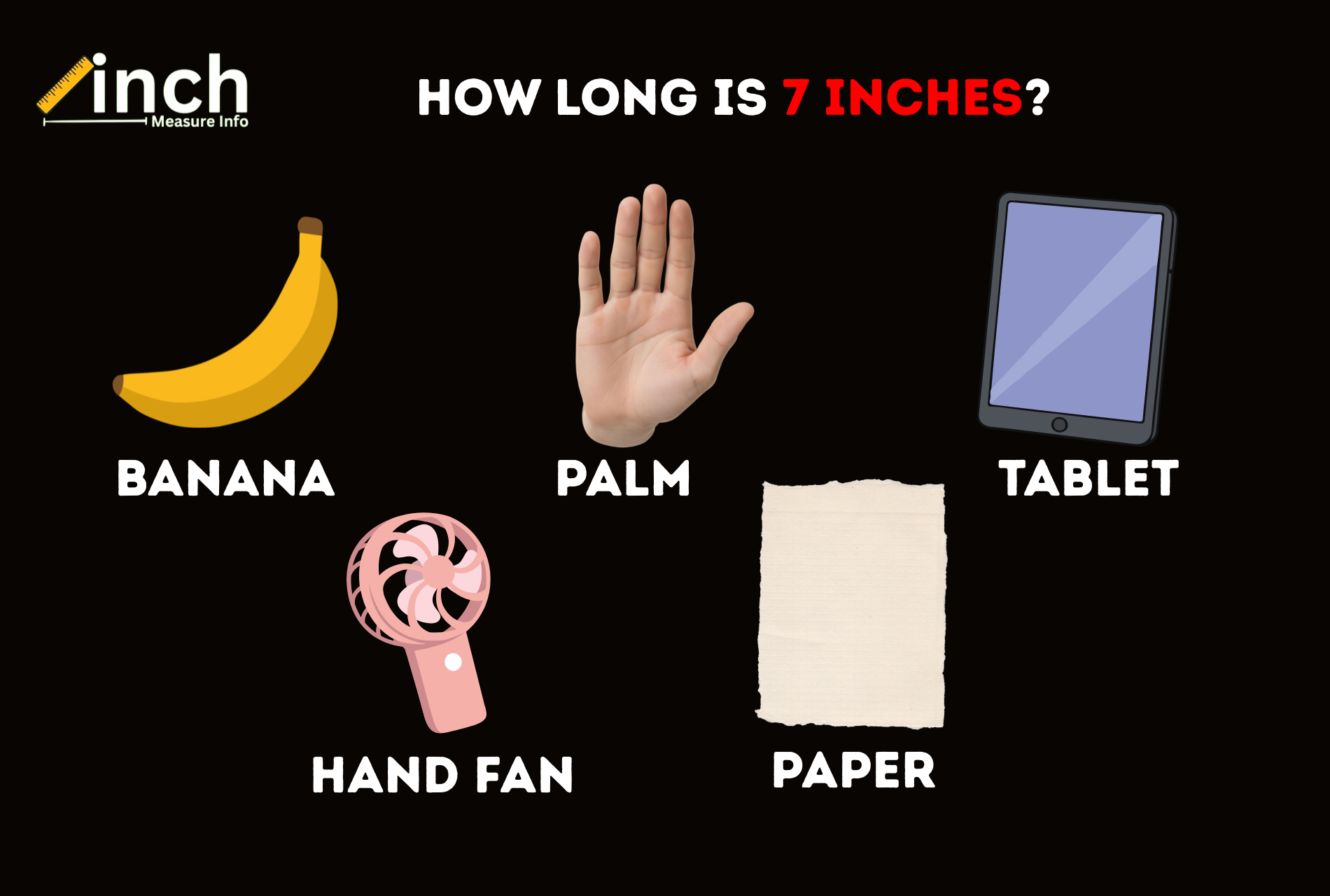
Visualizing 7 inches can be tricky without a reference point, especially if you’re not holding a ruler. Imagine a length that’s just a bit longer than the width of your hand (for most adults, the palm spans about 4 inches, so 7 inches is roughly 1.75 times that). It’s not overwhelmingly long—like the span of a small notebook page—but substantial enough for everyday items.
To put it in perspective, 7 inches is about the height of a stack of seven standard playing cards piled up, or the diagonal of a small tablet screen. If you’re into fitness, it’s roughly the length of a standard protein bar wrapper unfolded. These mental images help bridge the gap between abstract numbers and tangible reality.
For a more precise feel, consider this: the inch has been officially defined since 1959 as exactly 25.4 millimeters, making measurements consistent worldwide. So, 7 inches equals precisely 177.8 millimeters—a fact that’s crucial for international trade and engineering.
(Visual Idea: Insert an image here of a hand holding a ruler marked at 7 inches, with everyday objects overlaid for scale. Alt text: “Visual representation of 7 inches compared to a human hand and ruler.”)
In practical terms, if you’re asking “what does 7 inches look like in real life,” think of it as compact yet functional. It’s the sweet spot for portability in gadgets or tools, where anything shorter might feel inadequate, and longer could be cumbersome. From my time experimenting with kitchen gadgets, I’ve found that 7 inches is ideal for a paring knife—long enough for control but short enough to maneuver easily.
Expanding on this, let’s consider scale in different contexts. In fashion, 7 inches might be the inseam drop for petite pants, or the heel height for bold stilettos. In nature, it’s the average length of a hummingbird’s wingspan—tiny but mighty. These varied lenses show how 7 inches isn’t just a number; it’s a dimension that fits seamlessly into our world.
To enhance understanding, here’s a simple table comparing 7 inches to smaller and larger lengths:
| Length | Description | Comparison to 7 Inches |
| 1 inch | Width of a thumb | 7 times longer |
| 4 inches | Credit card length | Almost double |
| 7 inches | Our focus | – |
| 12 inches | One foot | About 58% of a foot |
| 24 inches | Two feet | Over three times longer |
This table illustrates relativity, helping you gauge “how long is 7 inches compared to a foot” at a glance.
Conversion to Other Units
Converting 7 inches to other units is straightforward once you know the basics. The imperial system, where inches reign, intersects with the metric system used globally. As per NIST standards, 1 inch equals exactly 2.54 centimeters. So, for 7 inches:
- Centimeters (cm): 7 × 2.54 = 17.78 cm. That’s about the length of a standard ballpoint pen.
- Millimeters (mm): Since 1 cm = 10 mm, 17.78 cm = 177.8 mm. Handy for precise engineering tasks.
- Feet: There are 12 inches in a foot, so 7 inches = 7/12 ≈ 0.583 feet. Or, roughly half a foot plus a bit.
- Meters (m): 7 inches = 0.1778 meters (or about 17.78 cm / 100). This is useful for scientific contexts.
- Yards: 7 inches is 7/36 ≈ 0.194 yards, but that’s less common.
For quick reference, here’s a conversion chart:
| Unit | Equivalent to 7 Inches | Common Use |
| Centimeters | 17.78 cm | Clothing sizes, international measurements |
| Millimeters | 177.8 mm | Jewelry making, small parts |
| Feet | 0.583 ft | Height descriptions |
| Meters | 0.178 m | Scientific reports |
| Kilometers | 0.000178 km | (Rarely used for such small lengths) |
(Visual Idea: Embed a simple online calculator here for users to input inches and get conversions. Alternatively, insert a table image with a colorful chart. Alt text: “Inch to metric conversion chart for 7 inches.”)
If you’re dealing with “how long is 7 inches in cm on a ruler,” remember that most rulers have dual scales—imperial on one side, metric on the other. In my experience measuring fabrics for sewing, I’ve always double-checked conversions to avoid cutting errors; apps like unit converters on your phone can be lifesavers for on-the-go calculations.
Long-tail queries like “convert 7 inches to mm for 3D printing” highlight niche needs. For instance, in hobbyist printing, 177.8 mm ensures parts fit perfectly. Always use reliable tools for accuracy, as even slight variances can compound in larger projects.
Real-Life Examples and Comparisons
To truly grasp “how long is 7 inches,” let’s tie it to familiar objects. Based on common references, here are some everyday items approximately 7 inches long:
- Standard Pencil: Unsharpened, it’s about 7.5 inches—close enough for a quick visual. Sharpen it down, and you’re spot on.
- Banana: An average Cavendish banana measures around 7 inches, perfect for scale in recipes or as a healthy snack prop.
- Toothbrush: Most adult toothbrushes are 7 inches, designed for ergonomic grip during brushing.
- Smartphone: Models like the Google Pixel 7 have a body length of about 6.1 inches, but with cases, it hits 7. Larger phablets diagonal screens approach this.
- Butter Knife: A typical one is 7 inches, ideal for spreading without excess reach.
- TV Remote: Many are 7 inches tall, fitting comfortably in hand.
- Sunglasses Case: Standard soft cases are around 7 inches to protect lenses.
Other unique ones: Ten business cards lined end-to-end, a small garden trowel handle, or a golf tee extended. In tech, some e-readers like older Kindles are 7 inches diagonally.
Comparisons add depth: 7 inches is longer than a credit card (3.37 inches wide) but shorter than a dollar bill (6.14 inches long). Stack two dollar bills for over 12 inches—double our focus.
In personal anecdotes, during a home renovation, I used 7-inch brackets for shelves; they provided sturdy support without overwhelming the space. For kids, it’s the length of many crayons or a small ruler—great for teaching measurements.
(Visual Idea: Insert a collage image of these objects next to a 7-inch ruler. Alt text: “Real-life examples of objects that are 7 inches long, including a banana, pencil, and toothbrush.”)
These examples show 7 inches’ versatility in household, tech, and nature contexts, making abstract queries like “how long is 7 inches compared to a phone” instantly relatable.
How to Measure Accurately
Accurate measurement is key to avoiding errors. Start with the right tools: A steel ruler or tape measure is best for inches, as they’re marked in 1/16ths for precision.
Steps for measuring:
- Align the zero: Place the ruler’s end flush with the object’s start.
- Read straight on: Avoid parallax error by viewing perpendicularly.
- Use fractions: 7 inches might be 7 + 1/8 for exactness.
Without a ruler? Improvise:
- Body parts: Your index finger is about 1 inch from tip to first knuckle; multiply by 7.
- Household items: A dollar bill is 6.14 inches—add a bit for 7.
- App or online ruler: Use digital tools like Ruler.onl for screen-based measuring.
In my woodworking hobby, I’ve learned that flexible tape measures excel for curves, while rigid rulers suit flat surfaces. For long lengths, story sticks (marked wood) reduce play in tape measures.
Common pitfalls: Stretching fabric or ignoring temperature expansion in metals. Always measure twice!
(Visual Idea: Insert a step-by-step infographic on using a ruler. Alt text: “Guide to accurately measuring 7 inches with a ruler.”)
Conclusion
In summary, 7 inches is a practical length equaling 17.78 cm or 177.8 mm, visualized through items like pencils, bananas, and toothbrushes. We’ve covered conversions, real-life comparisons, and accurate measuring techniques, all backed by NIST standards for trustworthiness.
Key takeaways: Use reliable tools for precision, leverage everyday objects for quick estimates, and always convert units for global contexts. This knowledge empowers better decisions in shopping, crafting, and more.
For more insights, check our related articles: “How Long is 5 Inches? Quick Comparisons” or “Inch to CM Conversion Mastery.” Stay measured!
FAQs
1. How big is 7 inches in real life?
7 inches is roughly the length of a large smartphone or a small ruler segment.
2. Is 7 inches long or short?
7 inches is considered a medium-small length in everyday objects.
3. How do you convert 7 inches into centimeters?
7 inches is equal to 17.78 cm.
