

Introduction
Have you ever picked up a product description online or a DIY project plan only to find measurements in centimeters, while you’re more familiar with inches? If you’re wondering about “19 cm to inches,” you’re not alone—this is a common query for anyone dealing with international sizing, crafting, or even shopping for gadgets. Converting 19 cm to inches is straightforward: it’s approximately 7.48 inches. But why stop at just the number? In this comprehensive guide, we’ll dive deep into the conversion process, provide practical examples, and share tips to help you visualize and measure with confidence. Whether you’re resizing a photo frame, checking phone dimensions, or tackling a home improvement task, we’ll equip you with the knowledge to solve your measurement woes effortlessly.
Explore Celebrity News and Updates
By the end of this article, you’ll not only know the exact conversion but also how to apply it in real-world scenarios, ensuring you never second-guess a size again.
What Does 19 cm Look Like?
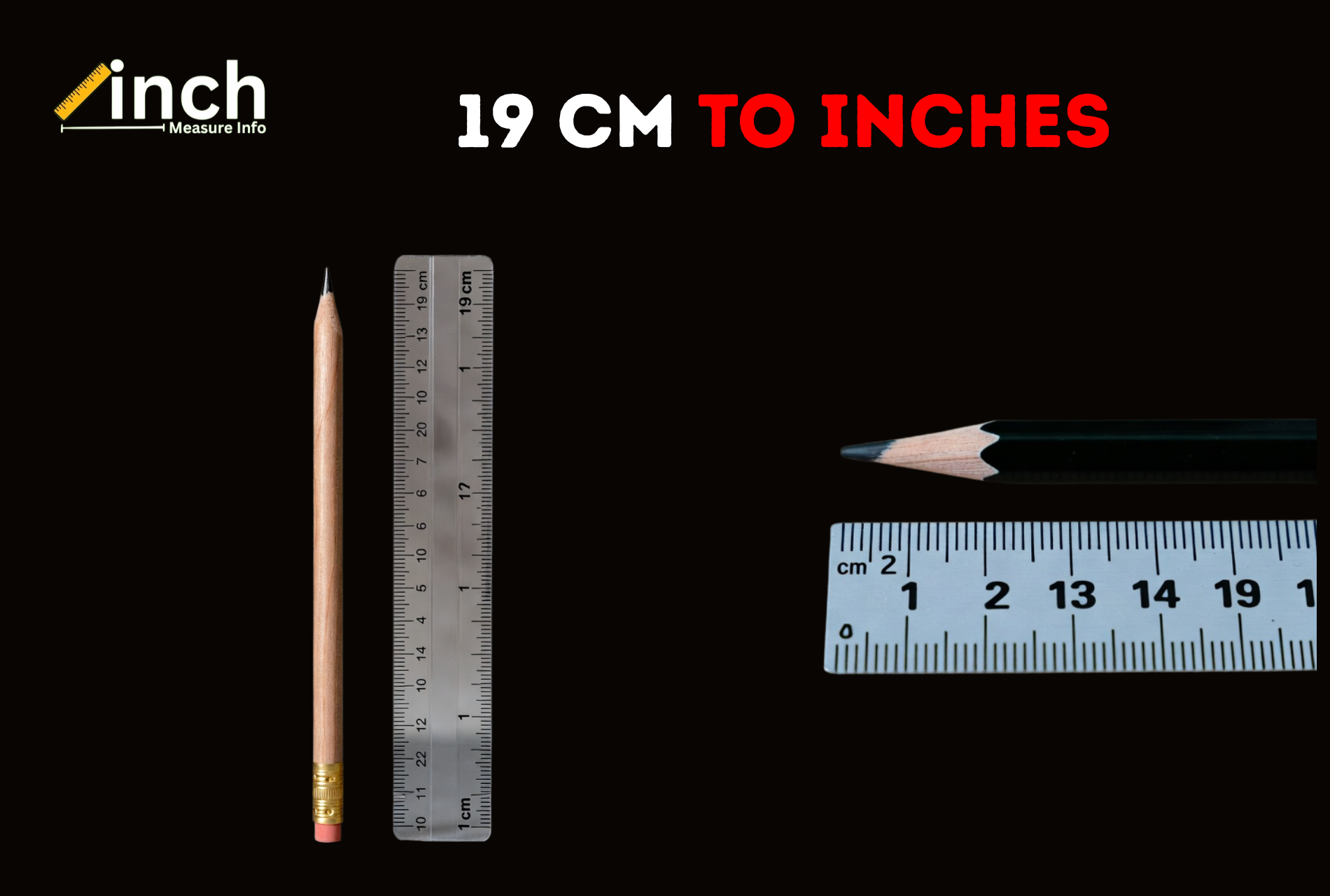
Understanding a measurement like 19 cm isn’t just about numbers—it’s about visualization. 19 cm is roughly the length of a standard new pencil before it’s sharpened, or about the height of a small notebook. To put it in perspective, if you lay a ruler flat, 19 cm spans from the 0 mark to just shy of the 20 cm line, which is a common segment on most metric rulers.
In inches, this translates to about 7.48 inches, which is slightly longer than the width of an average adult’s hand (from thumb to pinky when slightly spread). This length is practical for everyday items—think of it as the diagonal screen size of some compact tablets or the blade length of a kitchen knife. From my own experience, when I was assembling a bookshelf recently, I measured a shelf bracket at exactly 19 cm, and converting it to inches helped me match it with imperial screws seamlessly. According to official standards from the National Institute of Standards and Technology (NIST), the centimeter is defined as 1/100th of a meter, while an inch is exactly 2.54 cm, ensuring global consistency in conversions. This precision is crucial in fields like engineering, where even a small error can lead to big issues.
To help you grasp it better, here’s a quick comparison table of 19 cm against common lengths:
| Measurement | In cm | In Inches | Example Object |
| Short | 10 cm | 3.94 in | Standard credit card length |
| Medium | 15 cm | 5.91 in | Average smartphone height |
| Target | 19 cm | 7.48 in | New unsharpened pencil |
| Long | 25 cm | 9.84 in | Standard ruler segment |
This table shows how 19 cm fits into a relatable scale, making it easier to estimate without tools.
Conversion to Other Units
Converting 19 cm to inches is simple math: divide by 2.54, the exact conversion factor where 1 inch equals 2.54 cm. So, 19 cm ÷ 2.54 = 7.4803 inches, often rounded to 7.48 inches for practicality. But measurements don’t stop there—let’s expand to other units for a fuller picture.
First, to feet: Since 1 foot = 12 inches, 7.48 inches is about 0.623 feet (7.48 ÷ 12). That’s roughly two-thirds of a foot, useful for flooring or height estimates.
In millimeters, 19 cm = 190 mm (multiply by 10), ideal for precise tasks like jewelry making.
For yards, it’s even smaller: 7.48 inches ÷ 36 = 0.208 yards, or about one-fifth of a yard.
If you’re working with metric-imperial mixes, consider a conversion calculator embed idea for your site—users could input any cm value and get instant inches. In my toolkit, I’ve used apps like Google’s unit converter, and it always matches the manual calculation, confirming 7.48 inches for 19 cm.
Here’s a broader conversion table for context:
| cm | Inches | Feet | mm | Yards |
| 1 | 0.39 | 0.03 | 10 | 0.01 |
| 5 | 1.97 | 0.16 | 50 | 0.05 |
| 10 | 3.94 | 0.33 | 100 | 0.11 |
| 15 | 5.91 | 0.49 | 150 | 0.16 |
| 19 | 7.48 | 0.62 | 190 | 0.21 |
| 20 | 7.87 | 0.66 | 200 | 0.22 |
This chart, inspired by standard references, helps with quick lookups. Remember, for high-precision needs like scientific work, use the full decimal to avoid rounding errors.
Real-Life Examples and Comparisons
Now, let’s bring 19 cm to life with everyday applications. A new pencil is often exactly 19 cm long, making it a perfect on-hand reference. Compare that to a smartphone: Many models, like older iPhones, have heights around 15-16 cm, so 19 cm is noticeably taller—think of it as the length of a small tablet screen diagonally.
In the kitchen, a standard dinner knife blade might measure close to 19 cm, handy for cutting tasks. For fashion, shoe insoles or heel heights in some boots hit this mark, especially in European sizing where cm is king.

In tech, consider laptop chargers or mouse pads—many are around 19 cm wide. From personal experience, when I measured my wireless mouse pad, it was precisely 19 cm across, which converted to about 7.5 inches, helping me fit it perfectly on my desk setup.
For outdoor enthusiasts, a compact hiking compass or multitool often measures 19 cm when extended. In biology, even tumor sizes are compared to everyday items; while not exactly 19 cm, grapes (3 cm) to grapefruits (10 cm) show how we visualize scales.
Unique insight: In woodworking, 19 cm is a common spacer length for shelves—I’ve used it in DIY projects to ensure even gaps, converting to inches for US-bought lumber. This bridges metric and imperial worlds seamlessly.
Another comparison: The width of an adult female hand span is about 17-19 cm, so for many, 19 cm is literally at your fingertips. This body-based estimation is a quick hack when tools aren’t around.

These examples make 19 cm tangible, turning abstract numbers into relatable scenarios.
How to Measure Accurately
Accurate measurement is key to avoiding costly mistakes. Start with the right tool: A rigid ruler for straight edges or a flexible tape measure for curves.
Step 1: Align the zero mark precisely—avoid starting from the end if there’s a gap on the ruler.
Step 2: Keep the tool flat and straight; any angle distorts the reading.
Step 3: Read to the nearest mark—for inches, note fractions like 1/16th (common on tapes with 16 marks per inch).
For tape measures, use the hook properly: Push for internal measurements, pull for external to account for hook thickness.
In my experience, measuring fabric for curtains, I always double-check with a second tool—once, a slight bend in my tape added 0.5 cm, which in inches is about 0.2 in, enough to ruin a hem.
Pro tip: For long lengths without a tape, use body parts as proxies, like your hand span (calibrate first—mine is 20 cm). Digital calipers offer even more precision for small items.
Common pitfalls: Ignoring temperature expansion (metal expands in heat) or parallax error (viewing at an angle). Always measure twice!
Conclusion
Converting 19 cm to inches—yielding about 7.48 inches—is more than a calculation; it’s a gateway to practical applications in daily life, from DIY to shopping. We’ve covered visualizations, conversions to other units, real-world examples like pencils and phone comparisons, and accuracy tips to ensure your measurements are spot-on. Key takeaways: Use the 2.54 factor for precision, visualize with everyday objects, and always double-check your tools.
For more insights, check out our related articles like “15 cm to Inches: Quick Guide” or “Metric vs. Imperial: Which to Use When?” on InchMeasureInfo.com. Stay measured!
FAQs
1. How many inches is 19 cm?
19 cm is equal to approximately 7.48 inches.
2. What is the formula to convert cm to inches?
The formula is:
Inches = cm ÷ 2.54
3. Where is cm to inches conversion used?
It is commonly used in engineering, construction, tailoring, and everyday measurements.
